

Threat Model and Security Guarantees
Trust Boundaries
Understanding what you must trust — and what’s protected by hardware or blockchain — is the foundation of evaluating dstack-cloud’s security. This page maps out trust boundaries, threat categories, and the guarantees the system provides.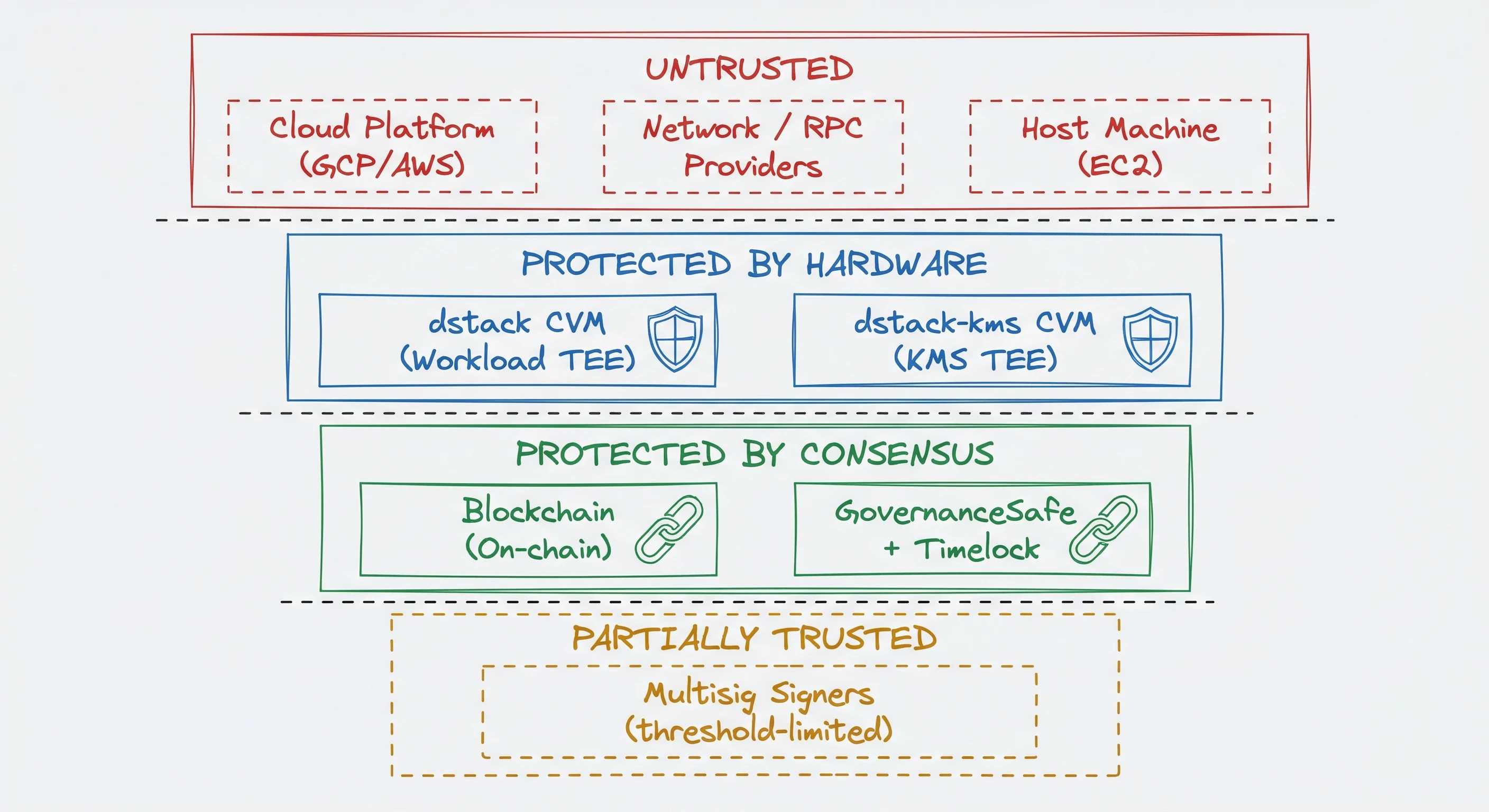
Untrusted
Protected by Hardware (TEE)
Protected by Blockchain Consensus
Partially Trusted
Threat Categories
T1: Malicious Cloud Platform Operator or Compromised Host OS
- Attack: Cloud provider or host OS administrator attempts to read workload memory or extract keys.
- Impact: Data breach, key compromise.
- Mitigation: TEE hardware encryption prevents memory access on both GCP (TDX) and AWS (Nitro Enclave). Attestation proves hardware authenticity.
- Residual risk: Microarchitectural side-channel attacks (speculative execution, etc.). See Residual Risks.
T3: Malicious or Compromised Workload
- Attack: An attacker gains control of a workload container inside the CVM or Enclave.
- Impact: Data within that container is compromised. The attacker may try to escalate to the Guest Agent (GCP) or dstack-util (Nitro).
- Mitigation: Container isolation within the CVM/Enclave. The Guest Agent (GCP) or dstack-util (Nitro) validates attestation before delivering keys.
- Residual risk: If the attacker can modify the CVM/Enclave image itself, the measurements change and KMS will refuse to deliver keys. On Nitro, since encryption strategy is user-controlled, a compromised workload may misuse any keys it has already obtained.
T4: Man-in-the-Middle / Network Attack
- Attack: Attacker intercepts communication between CVM and KMS, or between CVM and external services.
- Impact: Key interception, data theft, configuration tampering.
- Mitigation: All communication uses TLS or RA-TLS. RA-TLS additionally verifies both parties’ attestation.
- Residual risk: TLS implementation vulnerabilities, certificate authority compromise.
T5: Compromised RPC Provider
- Attack: Attacker operates a malicious RPC node that returns false blockchain state.
- Impact: KMS may accept unauthorized measurements or reject authorized ones.
- Mitigation: Use multiple independent RPC providers. KMS should verify blockchain state across sources.
- Residual risk: If all RPC providers are colluding or compromised.
T6: Compromised or Colluding Multisig Signers
- Attack: Multiple signers collude to push through unauthorized governance changes (e.g., register malicious measurements).
- Impact: Unauthorized workloads receive keys from KMS.
- Mitigation: Signature threshold (≥ 2/3) limits the number of signers that must be compromised. Timelock provides a window for detection.
- Residual risk: If enough signers collude to meet the threshold, the system is compromised.
T7: Covert Deployer Attack
- Attack: A workload deployer secretly modifies the application code after deployment.
- Impact: The workload behaves differently from what was approved.
- Mitigation: On-chain measurement registration. Any code change produces new measurements. KMS refuses to deliver keys to unregistered measurements.
- Residual risk: If the attacker can register the new measurements through governance without being detected.
Security Guarantees
Residual Risks
These are risks that the current architecture does not fully mitigate:Security Checklist for Deployments
Before going to production, verify: TEE and Attestation:- dstack OS image is built from audited source code
- All measurements (RTMR / OS_IMAGE_HASH) are registered on-chain
- TLS certificates are valid and properly configured
- Multisig signers are using hardware wallets
- Signature threshold is ≥ 2/3
- Timelock delay is appropriate for your risk profile
- Multiple independent RPC providers are configured
- Monitoring and alerting are set up for attestation failures and governance events
- Runbook exists for common failure scenarios
Next Steps
- Glossary — Definitions of security-related terms
- Runbook — Troubleshooting security-related issues
- dstack Security Model — Official security model document