

Attestation Integration
Remote attestation is how a TEE proves it’s running genuine, unmodified code on real hardware. dstack-cloud integrates two different attestation mechanisms — Intel TDX on GCP and AWS NSM on Nitro — to give KMS confidence before dispatching keys.For the fundamentals of dstack remote attestation, the RA-TLS (Remote Attestation TLS) protocol design, and ZT-TLS / ACME certificate management, refer to the official Phala documentation:
What Is Remote Attestation
Remote attestation is the process by which a TEE proves its identity and integrity to an external party. The proof contains:- Hardware signature — Confirms the workload is running in genuine TEE hardware (not emulated)
- Workload measurements — Cryptographic hash of the code and configuration running inside the TEE
- User data — An optional challenge value to prevent replay attacks
Attestation on GCP (Intel TDX + vTPM)
On GCP, dstack uses a dual-attestation approach combining Intel TDX and Google-managed vTPM to build a comprehensive trust chain.Architecture Overview
GCP Confidential VMs provide two independent attestation mechanisms:
dstack binds these two mechanisms together to provide defense-in-depth attestation.
Attestation Creation Flow
When a dstack CVM starts on GCP, the Guest Agent performs the following steps:- Collect report_data (64 bytes), optionally bound to an RA-TLS public key
- Generate TDX Quote via
tdx-attest::get_quote(report_data):- Includes all measurement values (MRTD, RTMR0-3)
- Signed by the Intel TDX module
- Read TDX event log via
cc-eventlog::tdx::read_event_log() - Compute TPM qualifying data as
sha256(tdx_quote)— this binds the two attestations together - Generate vTPM Quote via
tpm-attest::TpmContext::create_quote(qualifying_data, policy):- Signed by Google’s vTPM attestation key
- Includes PCR values representing boot chain integrity
- Package attestation as
DstackGcpTdxQuote { tdx_quote, tpm_quote }
Trust Chain Binding
The key innovation is the qualifying data binding:- TDX Quote proves the workload runs in genuine Intel TDX hardware with specific RTMR values
- vTPM Quote proves the boot chain integrity via PCR values
- The SHA-256 binding ensures both attestations come from the same CVM instance
Verification Flow
The verifier (e.g., KMS) performs dual verification: TDX Verification:- Retrieve TDX collateral and verify quote signature using Intel’s TCB (Trusted Computing Base) info
- Verify TCB status (debug mode disabled, mr_signer_seam valid)
- Replay runtime events and compare RTMR3 with quote’s RTMR3
- Verify
report_datamatches expected value
- Retrieve vTPM collateral and verify quote signature using Google’s certificate chain
- Replay runtime events and compare PCR values
- Verify
qualifying_data == sha256(tdx_quote)— confirms binding
Measurement Registers (GCP)
TDX RTMR Registers:
vTPM PCR Registers:
The vTPM provides an independent measurement of the boot chain. While dstack primarily relies on TDX RTMRs for application attestation, the vTPM PCRs offer an additional layer of verification for the boot process.
Note: For detailed PCR assignments and event log structure, refer to the GCP Confidential VM Attestation Documentation.
Attestation on AWS Nitro (NSM)
When a Nitro Enclave launches from its EIF (Enclave Image File):- NSM auto-generation — The Nitro Secure Module automatically generates an Attestation Document when the Enclave launches
- Document contents — The Attestation Document includes:
- PCR0-2 values (Platform Configuration Registers) — 3 measurements generated during EIF build
- NSM signature
- Enclave ID and launch timestamp
- OS_IMAGE_HASH — The 3 PCR values (PCR0, PCR1, PCR2) are combined into a single
OS_IMAGE_HASH, which serves as the unique workload identifier - Verification — KMS verifies the Attestation Document:
- Validates the NSM signature using AWS root certificates
- Checks that the
OS_IMAGE_HASHmatches an authorized value registered on-chain - Confirms the Enclave is running on genuine Nitro hardware
Measurement Registers (Nitro)
These 3 PCR values are combined into a single
OS_IMAGE_HASH, which is the unique identifier used for on-chain authorization. Any change to the Dockerfile, application code, or dstack-util version produces a different OS_IMAGE_HASH.
GCP vs. Nitro: Attestation Comparison
Both platforms generate hardware-signed attestations that KMS verifies before dispatching keys. The main differences are in the attestation format (TDX Quote vs. NSM Document), verification method (Intel DCAP QVL vs. AWS certificate chain), and how measurements are stored (RTMR registers vs. PCR values). For platform-specific details, see the sections above. For a broader architectural comparison, see AWS Nitro Enclave Integration.Measurements and On-chain Authorization
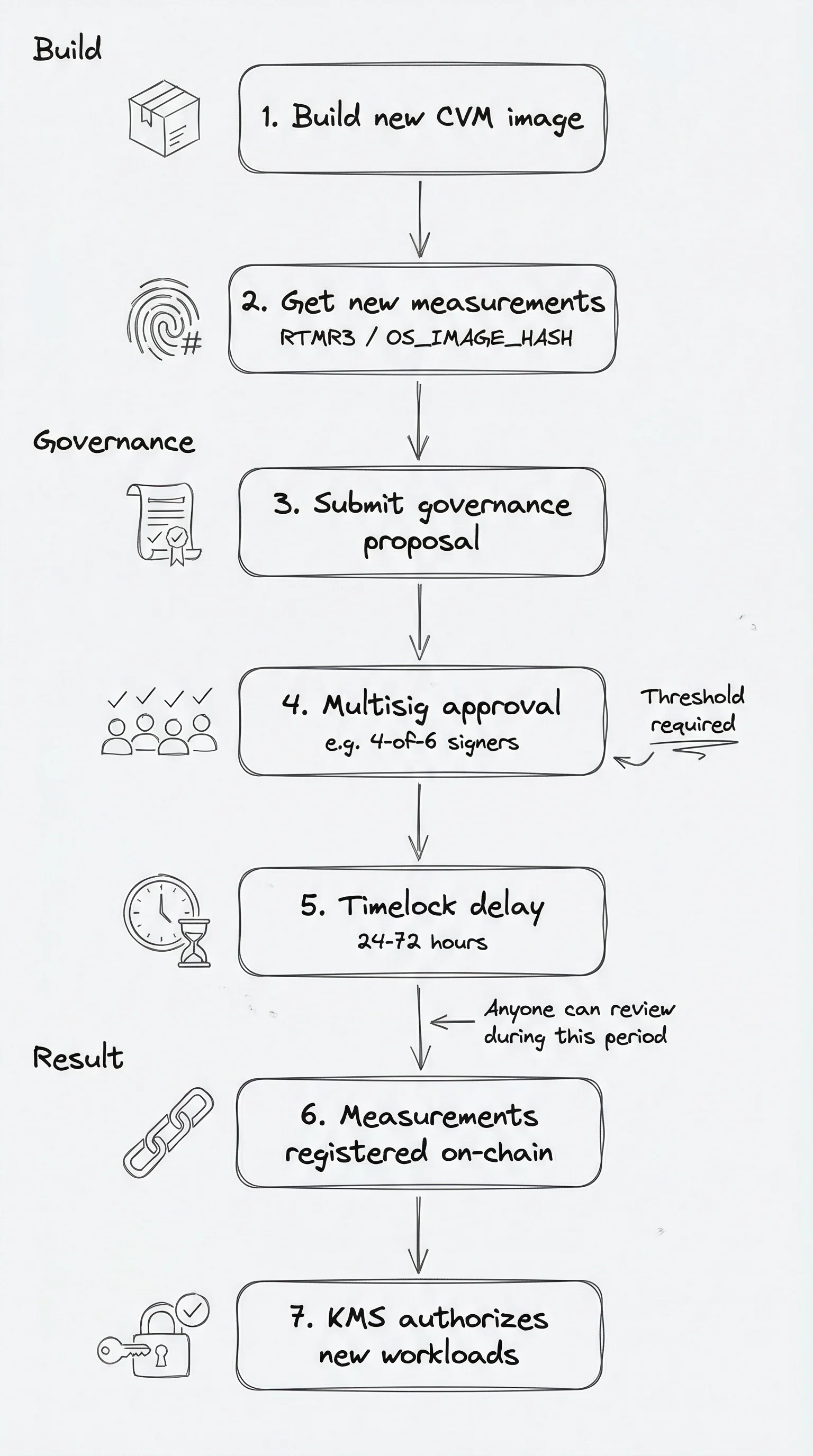
Measurements are the foundation of on-chain key access control:- Before KMS dispatches keys to a workload, the workload’s measurements must be registered on-chain
- This ensures only audited, approved code versions can obtain keys
- If you update your application code, the measurements change, and you must re-register them through governance
Verifying Attestation
You can verify that a dstack CVM is running in genuine TEE by requesting its attestation:- dstack-verifier — HTTP service or CLI tool provided by dstack-cloud
- dcap-qvl — Open-source Intel DCAP Quote Verification Library
- dstack SDK —
replayRtmrs()function for local verification
Next Steps
- Security Model — Trust boundaries and security guarantees
- Register Workload Measurements — How to register measurements on-chain
- Runbook — Troubleshooting attestation failures